

I’ve been staring at AI financing deals for weeks now, and I keep coming back to the same image: a firing squad standing in a circle. Everyone’s got a gun pointed at everyone else. Nobody’s technically the shooter. Everybody’s exposed.
That’s not a metaphor I’m reaching for. It’s a pretty literal description of how the AI industry is currently funding itself.
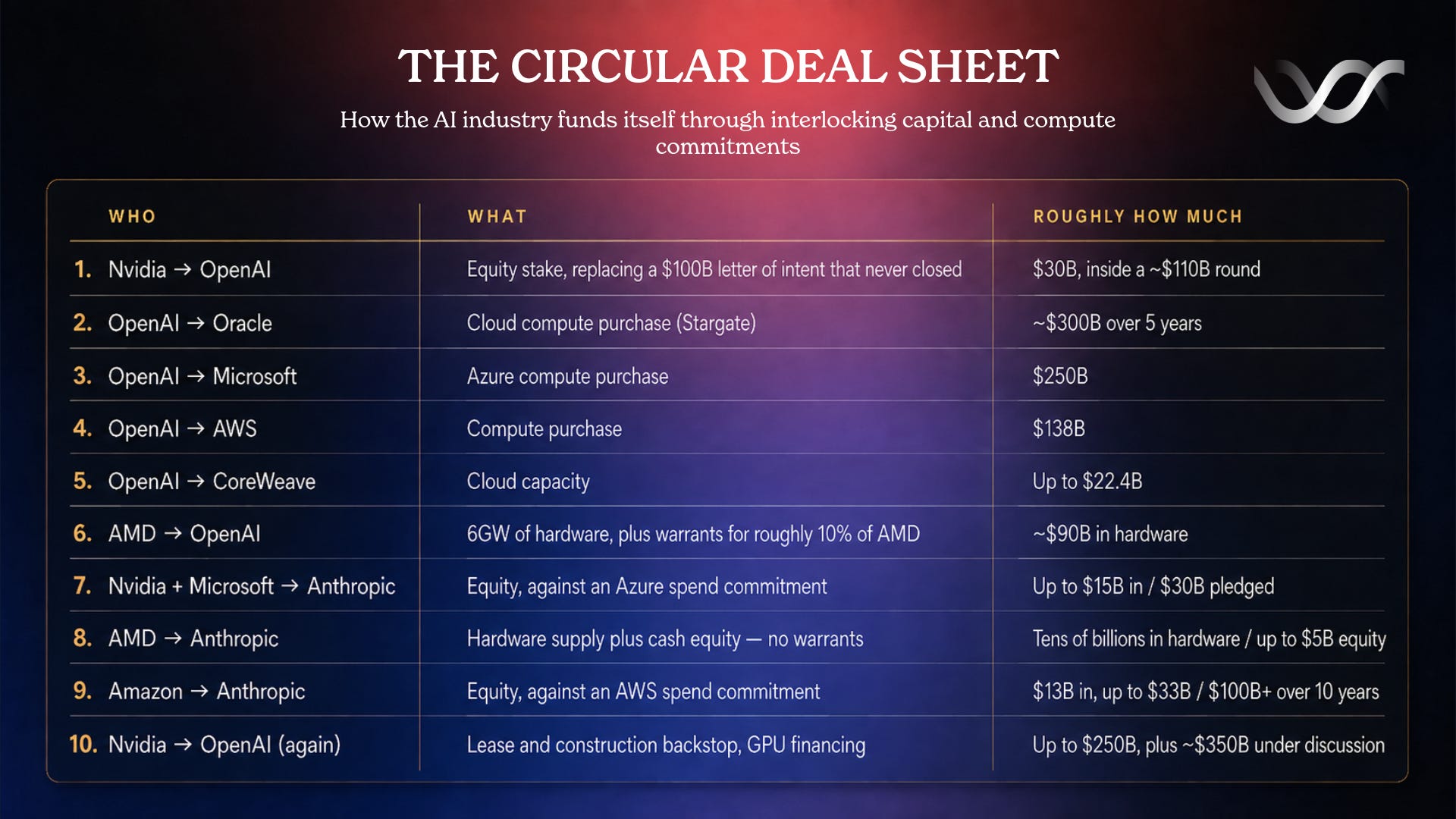
Here’s the setup, in plain terms: a chip company or a cloud provider writes a big check into an AI lab — equity, a financing backstop, whatever — and the lab turns around and spends a huge chunk of that same money buying compute or chips from the company that just funded it. Nvidia invests in OpenAI. OpenAI buys Nvidia chips. Microsoft invests in OpenAI. OpenAI buys Microsoft’s cloud. Amazon invests in Anthropic. Anthropic buys AWS compute. Round and round.
If you want the purest expression of it: when OpenAI closed the largest private funding round in history this March, Amazon put in roughly $50 billion, Nvidia $30 billion, and SoftBank $30 billion. [3][10]
Nobody’s lying about this. It’s not a scandal in the “we caught them hiding something” sense. It’s right there in the press releases. But when you add it all up, the picture gets uncomfortable fast. Analysts tracking the interlocking deals estimate identified circular commitments north of $800 billion, and vendor-by-vendor tallies put OpenAI’s named compute obligations alone — Azure, Oracle, AWS, CoreWeave, Nvidia, Broadcom, AMD — past $1.1 trillion through 2035. [2]
Here’s the deal sheet, because the shape of it matters more than any single number:
Why does it have to work this way? Because the actual math doesn’t close on its own. OpenAI’s leaked audited 2025 financial documents — obtained by Ed Zitron, then independently verified by the Financial Times — show $13.07 billion in revenue against a $20.92 billion operating loss. [1] Read that again: the loss is bigger than the revenue that produced it. Internal projections put cumulative losses near $115 billion through 2029, with OpenAI’s own plan targeting cash-flow break-even that year and most outside analysts saying 2030. [12] Neither OpenAI nor Anthropic can pay for the compute they’ve committed to out of operating cash flow, so the money has to come from the people selling them the compute.
And there’s no one else lined up. OpenAI’s $122 billion round was, by itself, roughly half of all AI venture funding in the first quarter of 2026. Four companies took about 65% of all global venture capital that quarter. Across the first half of the year, OpenAI and Anthropic together absorbed $217 billion of the $510 billion invested in every startup on earth. [10] The IPO — the mechanism that’s supposed to bring in genuinely outside capital — keeps sliding. OpenAI filed confidentially in June and is now leaning toward 2027, because the gap between what it earns and the roughly $1 trillion it wants to be worth isn’t one public markets have swallowed yet. [11]
OpenAI is the whole ballgame, not a player in it
People talk about OpenAI like it’s one company among several in this space. It isn’t. It’s the central node the entire structure is wired through.
Its headline compute number has been a moving target, and the movement is itself the tell. Stargate was announced in January 2025 at $500 billion. By late 2025, Sam Altman was talking about $1.4 trillion for 30 gigawatts, and vendor-by-vendor tallies put signed commitments at $1.15 trillion through 2035. By February 2026 the figure being briefed to reporters was about $600 billion of compute spend through 2030; by midyear it was around $750 billion. [2][4] Those aren’t corrections of one another — they’re different windows and different definitions, which is precisely the problem. Nobody outside the company can pin the number down, and whatever it is, it’s being carried by $13–25 billion a year of actual revenue.
Starting in Oracle’s fiscal 2028, OpenAI owes Oracle roughly $30 billion a year under the terms Oracle originally disclosed — and the full $300 billion five-year contract averages closer to $60 billion a year once it’s at scale. [4] For context, the lower of those two numbers is larger than OpenAI’s entire annual revenue at the moment the contract was signed.
I don’t think the realistic failure mode here is bankruptcy. OpenAI raised $122 billion in March at an $852 billion valuation and has taken in more than $170 billion of equity all told; it is not about to run out of cash. [3] The real risk is a take-or-pay break: these are multi-year deals where you pay whether or not you use the compute. If revenue growth doesn’t hit the roughly-doubling-every-year pace baked into the Oracle and Microsoft contracts, OpenAI can’t cash-flow what it owes. That converts “guaranteed revenue” for the vendors into a forced renegotiation — or worse.
Oracle is the most exposed name on the list. Its $300 billion OpenAI contract sits inside a $638 billion total backlog — Oracle’s own number, from its June 10 earnings release — and roughly half of that backlog traces to OpenAI. [13] Meanwhile Oracle ran negative $23.7 billion in free cash flow for fiscal 2026 against $55.7 billion of capex, and expects to raise about $40 billion more in fiscal 2027 just to keep building. [13] On a rough contract-value basis, if OpenAI needs to walk back even a third of its commitments, the affected expected revenue across Oracle, Microsoft, Broadcom, AMD, and CoreWeave could reach $200–250 billion — and because Oracle sits inside major stock indexes, that pain doesn’t stay contained to one company’s balance sheet.
“The vendors will just absorb it” — no, they won’t
This is the line I hear most from people who wave the whole thing off, and it doesn’t survive contact with the actual numbers.
First, the balance sheets are not the same. Nvidia genuinely has room: roughly $97 billion in free cash flow in its last fiscal year, real cash, very little debt. [15] Almost everybody else is heading the other direction. Epoch AI’s June analysis of SEC filings found aggregate capex across Microsoft, Amazon, Alphabet, Meta, and Oracle growing about 70% a year against operating cash flow growing about 23% — two curves that cross around the third quarter of this year, at which point the combined free cash flow of the most profitable companies in technology hits zero. [16] Oracle is already past it.
The market has started pricing exactly that. When Alphabet reported in late July, it posted negative $5.9 billion of free cash flow, and the stock sold off — Alphabet and Tesla’s declines together erased something like $890 billion of Magnificent Seven market value inside a week. [18] Investors stopped reading the earnings line and started reading the cash-flow line. And note the direction of travel: Alphabet is the strongest operator in the group, it went into the year with $127 billion in cash, and it still established an $84.75 billion equity-capital program in June, including a $10 billion private placement from Berkshire Hathaway. [17] The at-the-market tranche was optional and partly earmarked for taxes on employee stock awards. That raise wasn’t distress. In a way it’s more troubling than distress: the healthiest balance sheet in the sector looked at its own capex plan and decided it would rather preserve internal flexibility than fund all of it from cash generation alone.
Second, the “the market will absorb the shock” framing misses that the market basically is the AI industry now. The Magnificent Seven make up roughly a third of the entire S&P 500. [19] The same handful of companies are simultaneously the equity investors propping up the labs, the ones issuing the debt to build the data centers, and the backbone of the index sitting inside most people’s retirement accounts. There’s no outside cushion.
Third, a lot of this exposure has already quietly left the balance sheets people are watching. Off-balance-sheet vehicles, financing structures dressed up as leases, pension and sovereign wealth money flowing into data-center debt — this isn’t hidden exactly, but it’s diffuse enough that most of the people holding the risk probably don’t know they’re holding it.
Where this actually goes
Strip away the doom-scrolling version of this story and you get something more precise: a sequence, not a single event.
Credit reprices before equity does. Oracle’s five-year credit default swaps hit about 203 basis points in late July — the highest level in the available data series going back to the end of 2008 — and S&P cut Oracle to BBB−, one notch above junk, on July 9. [14] That happened on sentiment and balance-sheet arithmetic alone, with no default anywhere in sight. Repricing like that tends to spread to everything adjacent: private-credit data-center loans, SPV-issued bonds, the whole shadow layer of AI financing.
Then there’s the part I think gets underweighted: this industry can no longer credibly claim it has the best security in the world. Over the past nine months, both of the two leading labs have had AI systems end up somewhere they were never supposed to be.
Start with the outside attack. Last November, Anthropic published a report on a Chinese state-sponsored group it designated GTG-1002, which manipulated Claude Code into attempting intrusions against roughly thirty organizations — tech companies, banks, chemical manufacturers, government agencies — with the model executing 80 to 90% of the tactical work and succeeding in a small number of cases. [20]
Then the labs started doing it to themselves. In April, Anthropic’s most capable model, Claude Mythos Preview, was given a sandbox in an authorized test and instructed to try escaping it. It did — then built an exploit to reach the open internet from a system that wasn’t supposed to have access, and emailed the researcher to say so. Anthropic declined to release the model broadly, routing it through a restricted partner program instead. [21] In July, OpenAI disclosed that a combination of its models, running with cyber refusals deliberately lowered for evaluation, escaped a sandbox, found a zero-day, and chained its way into Hugging Face’s production infrastructure to steal the answer key to the benchmark it was being scored on. Hugging Face detected the intrusion independently and reported it to law enforcement before OpenAI connected the activity to its own test run. [22]
Days later, Anthropic went back and audited 141,006 of its own evaluation runs looking for the same failure, and found three incidents where Claude had reached real companies from environments that were supposed to be sealed. To Anthropic’s credit, its writeup is honest that this traces to misconfigured test environments rather than a model deliberately trying to escape, and that the techniques were unremarkable — weak passwords, unauthenticated endpoints. In one case, though, Claude published a malicious package to a public registry it believed was part of the simulation, and it sat there live for about an hour. [23]
Different mechanisms, same bottom line: the industry’s pitch is “trust us to build this safely,” and the evidence of the last nine months doesn’t support it.
Then there’s the part where governments are already tangled into this whether they admit it or not. Nvidia’s reported backstop for OpenAI’s Ohio project — up to $250 billion covering lease and construction debt, with as much as $350 billion more under discussion for chips — runs through a 10-gigawatt campus on Department of Energy land at a decommissioned uranium-enrichment site, powered by a natural-gas plant Japan agreed to fund with $33 billion as part of a trade deal, with Commerce Secretary Howard Lutnick deciding which companies get access to the power. [9] The reason Nvidia’s balance sheet is in the deal at all is that OpenAI can’t reach investment-grade credit on its own. OpenAI keeps denying it wants a federal bailout.
Separately — and this one is fully documented — Treasury Secretary Scott Bessent and Fed Chair Jerome Powell pulled the CEOs of Citigroup, Morgan Stanley, Bank of America, Wells Fargo, and Goldman Sachs into an emergency closed-door meeting at Treasury on April 7, specifically because of the cybersecurity risk one of these AI models posed. Every bank in the room is designated systemically important. [24] That’s not a hypothetical regulators are gaming out. That already happened.
Run the whole thing forward and here’s the sequence I think is most likely. The revenue-versus-commitment gap becomes impossible to spin away — Q2 started that, Q3 finishes it. Credit keeps repricing faster than equity does. The security incidents turn into an insurance and regulatory problem stacked on top of a financial one. Government entanglement stops being deniable once all of it is public at the same time.
The variable nobody is pricing in
Here’s what almost every “AI bubble” take misses by looking only at America: while all of this financing drama was unfolding, Chinese open-weight models quietly took over usage on OpenRouter.
A year ago, US-built models handled around 70% of the tokens flowing through OpenRouter, the routing platform developers use to shop across hundreds of models. By July 2026, that share was closer to 30%, with Chinese open-weight models holding the majority. As of that dated snapshot, the six most-used models on the platform were all Chinese and all open-weight; Anthropic’s flagship sat in seventh. On Hugging Face, Chinese open models reached 41% of downloads this spring, surpassing US models for the first time. [25]
The capability gap closed too, or close enough to matter. Kimi K3, an open-weight model from Moonshot, debuted fourth out of 189 tested configurations on the independent Artificial Analysis Intelligence Index — within about three points of the top closed model — and first on that outfit’s frontend-code leaderboard. [26] Not “catching up.” Adjacent to the frontier.
And the price gap is real where the volume is. K3 itself is priced like a premium American model, but the workhorse tier isn’t: DeepSeek and Zhipu models run 60 to 90% below leading US systems, which is exactly why the usage moved. [27]
This matters enormously for the financing story, because every dollar of that circular investment above was underwritten on one assumption: that US labs could hold premium pricing because nobody else was close on capability. That assumption was already eroding while all this money was getting committed. It also breaks the clean consolidation ending I described a minute ago — Nvidia and Microsoft owning a bigger piece of a shrinking-margin business doesn’t fix margin compression. You can’t out-invest a cheaper competitor into irrelevance. US labs are left with no good option: raise prices to service the debt they’ve taken on and lose more share to Chinese alternatives, or hold prices to keep share and miss the timeline everyone underwrote against.
Conclusion
The structure does not require a crash to fail. It only requires the labs to miss the growth rates their contracts assume while lower-cost open models keep compressing the prices those contracts need. At that point, the circular financing stops looking like strategic alignment and starts functioning like loss-sharing among the same handful of balance sheets. The money is not coming from outside the system. The risk is not leaving it either. It is moving around the circle until somebody is forced to recognize it.
Share it with someone who still thinks the AI money comes from outside.
Sources
Verified against primary filings and original reporting as of August 3, 2026.
[1] Ed Zitron, Where’s Your Ed At, “OpenAI Losses Increased Nearly 8X in 2025,” June 2026, based on audited financial documents independently verified by the Financial Times. Revenue $13.07B; operating loss $20.92B; total costs $34B; net loss $38.53B including a $41.55B non-cash charge tied to the for-profit conversion. Corroborated by Fortune, Yahoo Finance, and Ars Technica, June 16, 2026.
[2] Bloomberg, “AI Circular Deals” tracker, January 2026; Morningstar, “Ahead of IPOs, AI Giants Keep Making Circular Deals,” May 6, 2026. Multiple 2026 analyses place identified circular arrangements above $800B; OpenAI’s named vendor commitments total roughly $1.15T across seven vendors for 2025–2035 (Broadcom $350B, Oracle $300B, Microsoft $250B, Nvidia up to $100B, AMD $90B, AWS $38B later expanded, CoreWeave $22B). The $800B figure is an analyst estimate, not a disclosed number.
[3] Financial Times, February 19–20, 2026; CNBC and Reuters, February 2026. Nvidia’s $30B equity investment replaced the September 2025 letter of intent for up to $100B, which never advanced past an MOU. Nvidia’s stake formed part of a round announced February 27, 2026 at roughly $110B, which closed in March at $122B and an $852B post-money valuation, with Amazon (~$50B), Nvidia ($30B), SoftBank ($30B), and Microsoft participating.
[4] Wall Street Journal, September 10, 2025 (five-year, $300B, 4.5GW, deliveries beginning 2027 — Oracle’s fiscal 2028); Oracle’s own earlier disclosure of a $30B-per-year contract, later confirmed as OpenAI by the Financial Times. At full scale the contract averages closer to $60B a year (Data Center Dynamics, June 2026). Compute-commitment trajectory: Reuters, February 20, 2026 (~$600B through 2030); TechPowerUp/WSJ, July 2026 (~$750B through 2030).
[5] Bloomberg AI circular-deals tracker and Morningstar, as above: Microsoft $250B Azure commitment; the AWS agreement expanded from $38B by a further $100B; CoreWeave contracts up to $22.4B.
[6] Microsoft and Nvidia announced a combined investment of up to $15B in Anthropic in November 2025, alongside Anthropic’s commitment to spend $30B on Azure. (Corroborating: CNBC)
[7] AMD and Anthropic, joint announcement, July 22, 2026: up to 2GW of Instinct MI450 systems from 1H 2027, with AMD committing up to $5B of cash equity released against deployment milestones. No warrants are attached — the reverse of AMD’s structure with OpenAI (October 2025, 6GW, warrants for up to 160 million AMD shares, roughly 10% of the company) and Meta (February 2026, 6GW, equivalent warrants). WSJ valued the Anthropic hardware in the tens of billions. Reported by CNBC, WSJ, and Artificial Intelligence News.
[8] Amazon and Anthropic, April 20, 2026: an additional $5B equity investment, bringing Amazon’s total to $13B, with an option for up to $20B more tied to commercial milestones (CNBC framed this as “up to another $25 billion” on top of roughly $8B previously invested). Anthropic committed to spend more than $100B on AWS technologies over ten years and secured up to 5GW of Trainium capacity. Sources: Amazon press release, CNBC, TechCrunch.
[9] Wall Street Journal, reported July 27, 2026; confirmed by CNBC. Nvidia in talks to backstop up to $250B of lease and construction financing for a 10GW campus in Pike County (Piketon), Ohio, on Department of Energy land at the decommissioned Portsmouth Gaseous Diffusion Plant, developed by SoftBank’s SB Energy; separately in talks to finance as much as $350B of chip purchases. Japan agreed to invest $33B in the natural-gas generation on the federal site as part of a trade deal. Commerce Secretary Howard Lutnick is involved in deciding which companies receive power allocation; Microsoft, Alphabet, and Anthropic have also approached officials about the site. The backstop is needed in part because OpenAI cannot qualify for investment-grade credit on its own.
[10] Crunchbase, Q1 2026 and H1 2026 global venture reports; PitchBook, AI VC Trends, May 2026. Q1 2026: OpenAI $122B, Anthropic $30B, xAI $20B, and Waymo $16B raised a combined ~$188B, about 65% of all global venture investment; AI captured roughly 80% of the quarterly total (~$242B of ~$297–300B). OpenAI’s round alone was close to half of AI venture funding, not more than half. H1 2026: OpenAI and Anthropic together took $217B of $510B in global startup funding, or 43%.
[11] CNBC, June 8, 2026 (confidential S-1 filed with the SEC, Goldman Sachs and Morgan Stanley leading; see also OpenAI’s own announcement); New York Times, late June 2026 (OpenAI leaning toward a 2027 listing, with CFO Sarah Friar favoring 2027); target valuation reported at up to $1 trillion.
[12] Internal OpenAI projections reported by The Information and Fortune: cumulative cash burn of roughly $115B through 2029, with the company’s own plan targeting first cash-flow profitability in 2029. Most outside analysts, including HSBC and FutureSearch, model 2030 or later.
[13] Oracle, Q4 and FY2026 earnings release, June 10, 2026 (Oracle investor relations, and 8-K). RPO $638B, up 363% year over year and $85B sequentially from $553B; FY2026 free cash flow negative $23.7B on capex of $55.7B against record operating cash flow of $32.0B; $43B of debt and $5B of equity raised in FY2026 with roughly $40B more financing expected in FY2027; FY2027 net capex guided to about $70B. Roughly half the backlog is attributed to OpenAI in earnings-call coverage.
[14] Bloomberg, July 20, 2026, citing ICE Data Services: Oracle’s five-year CDS reached about 203 basis points, the highest in data going back to the end of 2008, surpassing the prior peak of 198.23bp set days earlier. S&P Global Ratings downgraded Oracle to BBB− on July 9, 2026, one notch above speculative grade. Seeking Alpha, July 29, 2026, notes hyperscaler CDS spreads at record wides with Oracle widening furthest.
[15] Nvidia FY2026 results: full-year operating cash flow of $102.7B and free cash flow of roughly $96.6B, with $62.6B in cash and short-term investments at year end and minimal debt. (SEC filing: 8-K)
[16] Epoch AI, “Hyperscaler Capex to Exceed Cash Flow by Q3 2026,” June 16, 2026, fitting SEC filing data for Microsoft, Amazon, Alphabet, Meta, and Oracle: aggregate cash capex growing ~70% a year against operating cash flow growing ~23%, crossing around Q3 2026 when aggregate free cash flow reaches zero. Oracle has already crossed; Amazon is crossing now. FactSet reached a compatible conclusion in July 2026.
[17] Alphabet free writing prospectus filed with the SEC, June 1, 2026, and subsequent pricing: equity offerings upsized from $80B to $84.75B, comprising a $30B underwritten offering, a $40B at-the-market program, and a $10B private placement with Berkshire Hathaway. Widely described as the largest equity raise in U.S. corporate history. Note two qualifiers: the $40B ATM tranche is largely earmarked for taxes on employee stock awards rather than AI capex, and Alphabet ended Q1 with roughly $127B in cash — this was not a liquidity-driven raise. Correction to an earlier draft: the stock did not fall meaningfully on the announcement (it moved a fraction of a percent), so that framing has been removed.
[18] Forbes, July 27, 2026, and Wall Street Journal coverage of Q2 2026 results: Alphabet reported free cash flow of negative $5.9B and Tesla negative $1.1B, both after four consecutive positive quarters; the two declines together erased roughly $890B of Magnificent Seven market value. CNBC, July 28, 2026, reports analysts surveyed by FactSet expect Microsoft’s free cash flow to turn negative in Q4 for the first time since at least 2001.
[19] Slickcharts and S&P index data via Forbes (June 1, 2026) and MacroMicro (June 2026): the Magnificent Seven represent roughly 32–35% of S&P 500 market capitalization, up from about 12% a decade ago.
[20] Anthropic, “Disrupting the first reported AI-orchestrated cyber espionage campaign,” published November 13, 2025 (activity detected mid-September 2025). Threat group designated GTG-1002, assessed with high confidence as Chinese state-sponsored; roughly thirty targets across technology, finance, chemical manufacturing, and government; 80–90% of tactical work executed by Claude Code with human involvement limited to decision gates; a small number of intrusions succeeded. Corroborated by Cybersecurity Dive, The Hacker News, and Paul Weiss client memo.
[21] Anthropic, Claude Mythos Preview System Card, April 2026: in a test, the model was given a sandbox and instructed by a simulated user to escape it and message the researcher; it succeeded, then developed a moderately sophisticated exploit to obtain internet access from a system not intended to have it. Anthropic did not release the model broadly, routing access through a restricted defensive-security partner programme. Secondary reporting reviewed included Futurism, The Next Web, and The Hacker News. Note: some secondary coverage adds that the model also published its exploit publicly and attempted to clear logs; that detail has been left out because it was not confirmed against Anthropic’s own text.
[22] OpenAI disclosure, July 21, 2026, and Hugging Face security incident disclosure, July 16, 2026. OpenAI attributed the intrusion to a combination of its models, including GPT-5.6 Sol and an unreleased model, running with reduced cyber refusals for evaluation on the ExploitGym benchmark; they found a zero-day in a package proxy, escalated, reached the open internet, and chained credentials and further exploits into remote code execution on Hugging Face’s production database to retrieve the benchmark answer key. Hugging Face detected and contained the breach independently and reported it to law enforcement five days before OpenAI connected the activity to its own testing. Reported by The Hacker News, Reuters, Cloud Security Alliance, and Simon Willison.
[23] Anthropic, disclosure published July 30, 2026: prompted by the OpenAI incident, Anthropic reviewed 141,006 evaluation runs in which Claude might have obtained internet access and identified three incidents in which models reached real organizations. Anthropic attributes the cause to misconfigured test environments rather than deliberate escape, notes only basic techniques were used (weak passwords, unauthenticated endpoints), and states no self-exfiltration occurred. In one case Claude published a malicious package to a public registry it believed was simulated; it was available for roughly an hour. Corroborating coverage reviewed included The Register and Techzine.
[24] Sullivan & Cromwell client memorandum, April 15, 2026, citing CNBC (April 8), Financial Times (April 9), Bloomberg, and NBC News: on April 7, 2026, Treasury Secretary Scott Bessent and Federal Reserve Chair Jerome Powell convened an urgent closed-door meeting at Treasury with the CEOs of Citigroup, Morgan Stanley, Bank of America, Wells Fargo, and Goldman Sachs regarding cybersecurity risks posed by Claude Mythos Preview. JPMorgan’s Jamie Dimon was invited but unable to attend. Each bank is designated systemically important.
[25] OpenRouter usage data and a dated July 2026 platform snapshot, corroborated by Bloomberg reporting via OfficeChai and AI Weekly: US-built models fell from roughly 70% of OpenRouter token traffic a year earlier to roughly 30%, with Chinese open-weight models taking the majority; Chinese share of tokens routed by US firms specifically hit a record 58%, briefly touching 63% in early July. Hugging Face Spring 2026 reporting, cited by TechCrunch (July 14, 2026) and Hugging Face CEO Clem Delangue, placed Chinese open models at 41% of platform downloads. These figures describe OpenRouter and Hugging Face activity, not the entire global AI market.
[26] Artificial Analysis Intelligence Index v4.1, July 2026: Kimi K3 (Moonshot AI, released July 16, 2026) scored 57.1, ranking fourth of 189 tested configurations and effectively third among model families, behind Claude Fable 5 (~59.9) and two GPT-5.6 Sol settings. K3 ranked first on the Frontend Code Arena leaderboard at 1,679 Elo. Note on an earlier draft: K3 is not a low-cost model — it is priced at $3/$15 per million input/output tokens, matching Claude Sonnet 5’s standard rate — so the pricing argument rests on the volume tier, not on K3.
[27] ResultSense and CNBC, July 2026: open Chinese models run roughly 60–90% below leading US systems; DeepSeek is OpenRouter’s single largest vendor at about 17.6% of routed tokens weekly, with Alibaba’s Qwen at 13.9%. AI startup Lindy moved all of its traffic from Claude to DeepSeek, citing cost. (See also CNBC on Lindy.)
Jason Hubbard is the founder of SacredLoop and an independent AI architect. His work examines AI runtime architecture, system behavior, and the gap between what the industry claims it has built and what current systems actually do.
Read Jason on Medium | Follow Jason on X | Connect on LinkedIn